
If you've been to a NAGs event, you've almost certainly seen Jill Smit somewhere in the mix: she's our Club President and the driving force behind so much of what makes NAGs tick, from the arena to the committee table and everywhere in between. Jill is also a National Dressage Judge, which means she brings a judge's eye to everything she does for the club. And when she's not organising, officiating, or generally holding the place together, you'll find her in the saddle herself, bringing her beautiful mare Fabienne (Fleur) up through the levels.
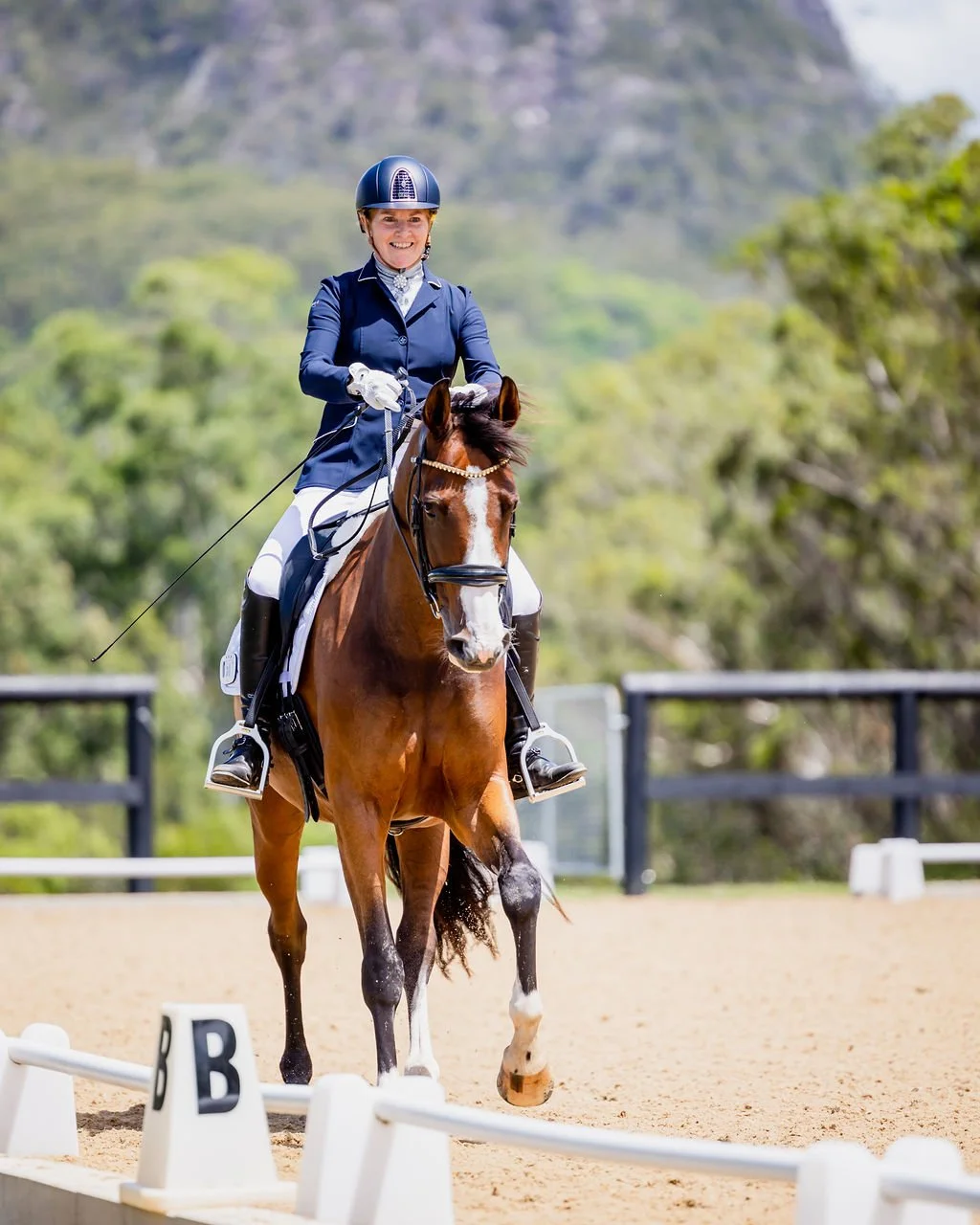
We asked Jill Smit, Club President and National Judge, what she enjoys most about judging.
Honestly, what I love most is watching the partnership between horse and rider come together in front of me. You get to see months, sometimes years, of training show up in just a few minutes in the arena, and there is nothing quite like watching a combination find that moment of harmony. I also love seeing riders come back season after season and improve. It is genuinely one of the most rewarding parts of the job, watching someone take last year's comments on board and turn them into a better test this year.
When you write comments about the horse, things like "not through" or "losing rhythm in the corner", what's actually happening in the test that prompts that specific wording?
Every test sheet has two halves, and once you know how to read them, the comments make a lot more sense. The first three columns are the 'TEST', telling you what to do: track right, ride a 20m circle. The fourth column, Directive Ideas, tells you how to do it, and that's what we're actually scoring against. In Preliminary 1.2, Movement 2 asks for a 20m circle right; the directive is 'regularity and quality of the trot.' So a comment like 'losing rhythm’ isn't a criticism; it's simply explaining why the mark wasn't higher: the horse lost regularity and quality in that moment. There can be lots of reasons for that, and most of them are completely fixable. The comment is really just the judge accounting for the score, so riders can read it against the directive and work out with their coach what training gap, or what one-off environmental factor, caused it. To understand why rhythm matters in the first place, it's worth going back to the Training Scale on page 15 of the EA National Dressage Rules. It's a great foundation for any rider's training.
Riders often see an accuracy comment (a shallow circle, a late transition, a missed marker) and read it as "I did something wrong." What's usually behind that kind of mark-down that riders don't realize?
Accuracy can look like a minor detail, but it's actually telling you something really useful: whether the horse is truly on the aids and following the rider's track. A genuinely accurate movement shows two things: the rider gave the right aid at the right time, and the horse understood and obeyed it. Plenty of riders focus on quality over accuracy in training, which is a perfectly reasonable approach, but to score an 8 or above, you need both, and the good news is accuracy is one of the easiest things to improve with a bit of homework. In Prep and Preliminary, the most common inaccuracy is a circle that isn't round. Riders should get to know the geometry of a 20m circle in the arena: where it starts, where it touches the track, where it crosses the centre line. The more precisely you shape the circle, the more the horse comes onto the aids, and that's a really rewarding thing to feel. A horse bulging or falling in on part of a circle is simply telling you the aids weren't clear yet, or weren't quite obeyed, nothing that a bit of practice won't fix.
When you notice the same issue recurring across several movements in a test, do you comment on it each time?
A judge and their scribe don't have time to comment on everything in a test, so we pick out what feels most relevant and most useful, and honestly, that's a gift to the rider, not a criticism. If the same comment turns up several times, that's usually the one issue we think matters most, and it's actually really helpful information, because it tells you exactly where to put your training focus. Say 'can be more forward' appears five times: that's a clear sign forwardness should be a real focus in training, because it's likely affecting marks even in the movements where we didn't have time to write it down. The collective marks at the end of the test often sum up the key reasons scores weren't higher, so that's a great place to start.
What's the biggest misconception riders have about what you're actually evaluating when you write your comments?
Try to read the comment alongside the mark, not on its own. It makes a real difference to how it lands. A 7 with 'maintained rhythm and balance' is telling you what earned that score. A 7 with 'can be more forward' tells you that the movement was “Fairly good”. The comment isn't taking anything away from the score, it's simply pointing you toward what would turn that 7 into an 8 or a 9. Ideally you're getting both types of comment across a test: what you achieved, and what to focus on next. Both are valuable, and both are there to help you keep improving.
Why does every movement get a score, but not every movement gets a comment?
Every movement is scored, that part's non-negotiable, but comments work a little differently. Wherever possible, judges are required to give a comment whenever a mark is 5 or below, or 8 or above. For lower marks, that comment gives the rider real insight into why the score was a little low. Sometimes it's a one-off, like an outside distraction that made the horse spook, a bit of isolated resistance, or a small mistake in the moment. Other times it points to something more fundamental in the training, like the horse not quite forward to the contact, or not holding a consistent rhythm. For the higher marks, 8 and above, the comment usually tells you exactly what worked, things like maintaining rhythm and balance throughout, the horse feeling supple and forward, or being clearly obedient to the aids. If you read the comment together with the mark and the directives for that movement, it becomes a really useful guide for where to focus your training and how to lift your scores.