
Rider Asymmetry Part 2 of 3: Three ways we compensate
This is the second of a three-part series on rider asymmetry, drawn from a recent seminar with Dr Russell MacKechnie-Guire of Centaur Biomechanics. Part 1 looked at what our crookedness asks of the horse. Part 2 looks at what our bodies do about it, and Part 3 covers where the fix starts.
When a rider’s body can’t quite organise itself over a moving horse, it finds a workaround. Russell described three that show up again and again. I’d be surprised if you don’t recognise at least one.
Tipping forward
The upper body pitches ahead of the movement. The seat slides towards the back of the saddle, the trunk loses its stability, the elbows wing out and the wrists curl. The back of the saddle gets loaded unevenly, and the rider ends up slightly out of time with the horse.
There’s a twist for rising trot. Sitting bolt upright isn’t the answer either. Russell’s work puts the trunk a touch forward of vertical, around a centimetre. Ride dead vertical and you land behind the movement, then catch yourself on the reins on the way back down.
Gripping with the knees
When balance feels uncertain, the knees clamp. It feels secure, but it lifts the seat out of the saddle, and Russell notes it may restrict how freely the horse’s front legs move. The thing we do to feel safe takes away some of the horse’s freedom.
Balancing on the reins
The elbows wing out, the wrists curl, and one hand sits higher or tighter than the other. Every compensation affects the horse, but this one goes a step further, because the bit sits inside the horse’s mouth. Uneven rein tension turns into mixed messages, and the elastic contact we work so hard for disappears.
One pattern, not four faults
These rarely arrive alone. Russell gave the example of a rider collapsing through the left side. Typically their hips push right, their trunk leans left, the left knee grips, and the left hand creeps towards the withers with more tension in the left rein. On a lesson sheet that reads as four separate faults. In the body, it’s one pattern.
That matters for how we fix it. One of Russell’s slides showed a rider’s head crammed with instructions: heels down, eyes up, find a stride, don’t fall off. Adding one more correction rarely helps when the rider’s attention is already full. Change the pattern at its root, and many of the separate faults ease on their own.
Try this on your next ride
Russell suggests a quick test on a 20 metre circle. I like to do it in an active walk: take both reins in your outside hand, keep your normal contact and ride a few circles. Notice what changes.
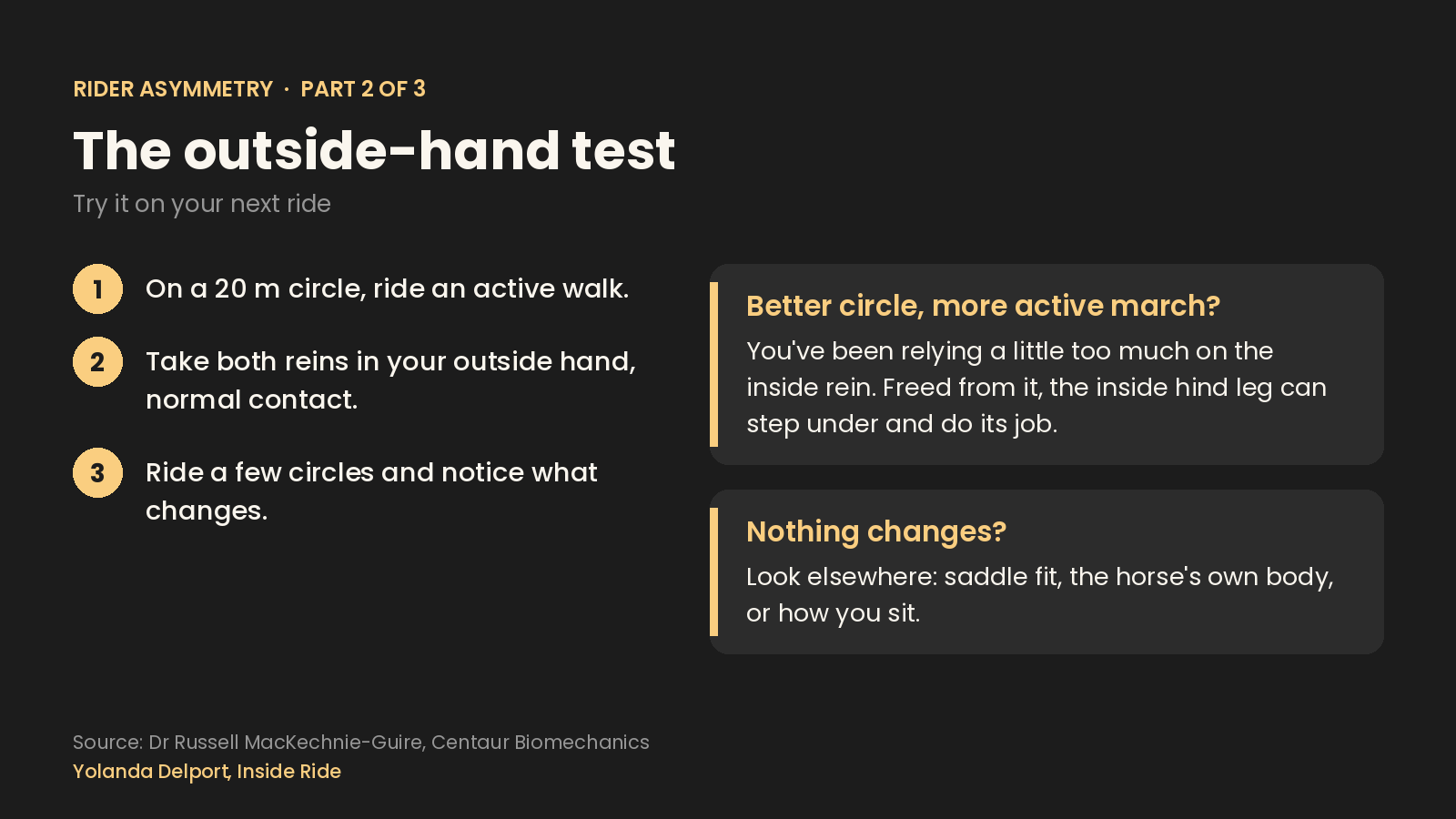
If the circle becomes a better shape and your horse feels like it’s marching more actively than usual, you’ve been relying a little too much on the inside rein in previous circle work.
That tells you a story. A busy inside rein turns the horse’s head and neck, but not the rest of the horse. The outside shoulder drifts out and the circle loses its shape. The inside hind leg needs room to step under the body, and a busy inside rein gets in its way. Take that rein out of the job and the hind leg is free to work, which is the extra march you feel.
The story carries on in the rider. In my experience, a cluster of compensations comes along with using too much inside hand to turn. The inside shoulder pulls back, the ribcage collapses on that side and the hip can hitch up with it. As we saw in Part 1, a collapse sends weight to the opposite side of the saddle. The rider ends up heavier on the outside seatbone, asking the horse to turn in while their weight is pushing it out. Ride enough circles that way and it stops being a moment and becomes a habit, one the horse learns to carry too.
If nothing changes, this too tells a story. Look elsewhere: saddle fit, the horse’s own body, or how you sit. Either way, you’ve learned something new today.
In Part 3, we step out of the saddle. Russell’s research points there as the place the fix begins, and it’s where I start with riders too, because you can’t change a pattern you can’t feel.
Yolanda Delport, Inside Ride