
Rider Asymmetry Part 3 of 3: Where the fix starts (hint: not in the saddle).
This is the final piece in a three-part series on rider asymmetry, drawn from a recent seminar with Dr Russell MacKechnie-Guire of Centaur Biomechanics. Part 1 looked at what our crookedness asks of the horse, and Part 2 at the workarounds our bodies reach for. This one is the hopeful bit.
Much of the fix for rider asymmetry happens off the horse. For riders who'd rather spend every spare minute in the saddle, that can be a hard sell. Stay with me.
First, it might not be you
Before anyone starts blaming their pelvis, a word on saddles. Russell shared a case study using the same horse and the same rider on the same day. The only change was the width of the saddle. With the wrong width, the rider showed what looked like classic rider faults. With the right saddle, many of those faults faded.
Straightness is a team effort. Your coach, your horse's body worker and your saddle fitter each see a part of the picture, and the answer often sits where those parts meet.
What your body does standing up, it does in the saddle
Russell assesses riders on the ground before he watches them ride. A few of his checks are easy to try at home.
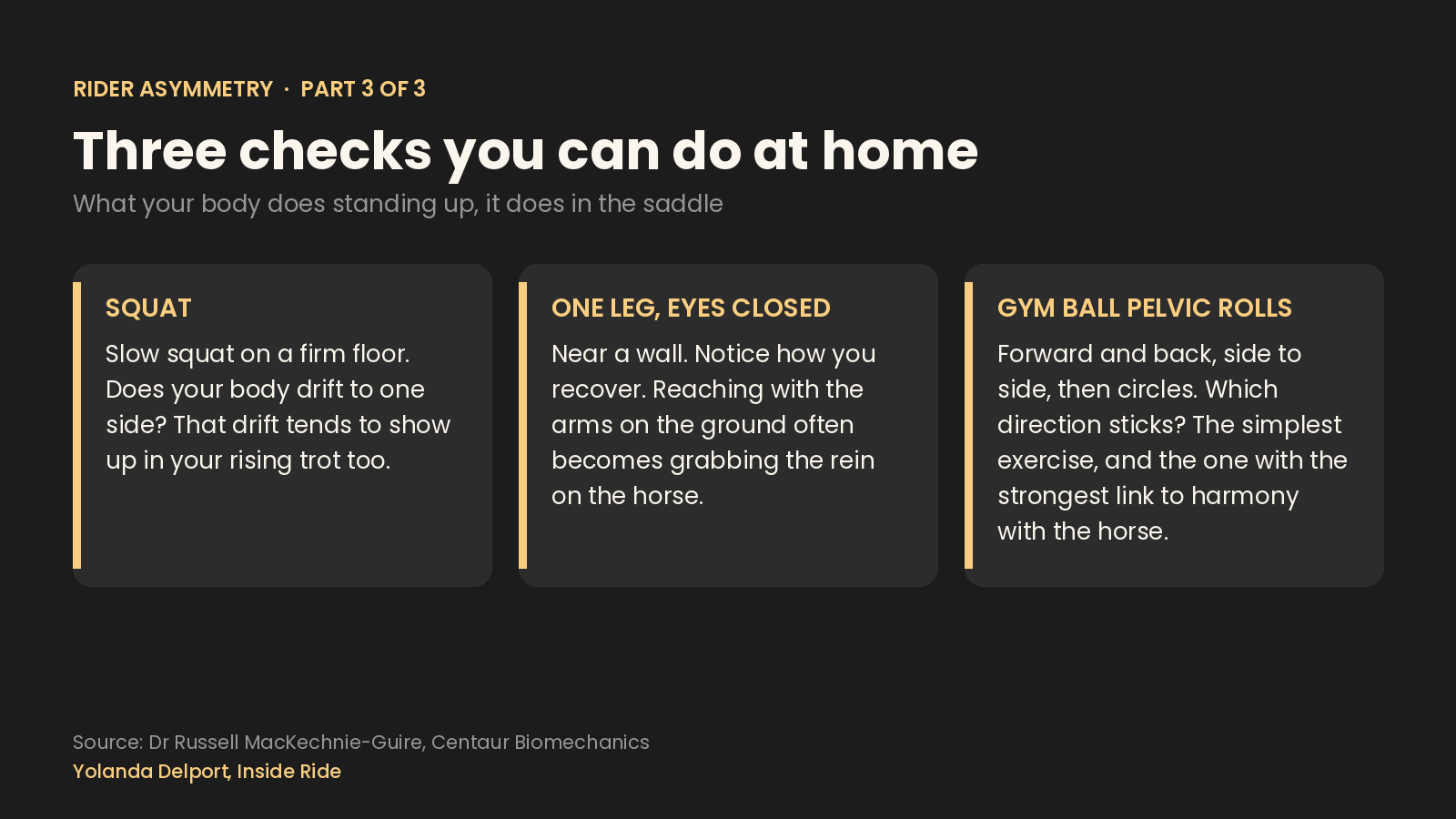
The squat. Do a slow, comfortable squat on a firm floor, in front of a mirror if you can. Many riders drift to one side without feeling it. Russell has found that this drift lines up with the drift in rising trot, and it can even predict which rein the asymmetry shows up on.
One leg, eyes closed. Stand near a wall and lift one foot, then close your eyes. Notice what you do to recover. Many riders reach out with their arms. On the horse, that same reach often becomes a grab at the rein.
The simplest exercise came out on top
Of everything Russell tested, the plainest exercise had the strongest link with results: sitting on a gym ball and rolling the pelvis forward and back, side to side, then in slow circles. In his research it was closely associated with riders moving in harmony with their horses and with fewer conflict behaviours from the horse. The fancier balance challenges on the ball, with arm and knee lifts, didn't show the same link.
As you roll, notice which direction feels smooth and which one sticks. That's your asymmetry showing itself, with no horse involved.
Does it carry back to the horse?
In one study, ten horse-and-rider pairs were measured in sitting trot before and after the riders followed a core program off the horse. The left-right difference in saddle pressure dropped significantly, and the horses' stride length increased. It's a small study, but the idea behind it is a lovely one: work on the rider, measure the horse, and the horse moves more freely.
Being crooked isn't a flaw
Every rider has a pattern. What matters is whether we know ours, and whether we give the body a chance to learn a new one. Small, regular habits off the horse and a curious eye on what shows up in the saddle go a long way.
Yolanda Delport, Inside Ride