
Rider Asymmetry Part 1 of 3: Is your horse carrying your crooked side?
This is the first of a three-part series on rider asymmetry. Part 1 looks at what our crookedness asks of the horse. Part 2 covers the three most common ways riders compensate, with a test you can try on your next ride. Part 3 is about where the fix starts, which is mostly out of the saddle.
One of the perks of temporarily hanging up my own riding boots is spare time. Time to read, time to research, and time for the courses I once squeezed in between riding and coaching. My latest was a seminar with Dr Russell MacKechnie-Guire of Centaur Biomechanics and Hartpury University in the UK. Russell has done performance analysis for British Equestrian teams for many years, and his topic was one close to my heart: rider asymmetry and what it does to the horse. It was too good to keep to myself.
We are all a little crooked
The comforting news first. Nobody sits perfectly straight, not even the riders you watch on the international stage. We all have a side we lean on, a hand that rides a little higher, a hip that likes to sit heavier. That's simply being human.
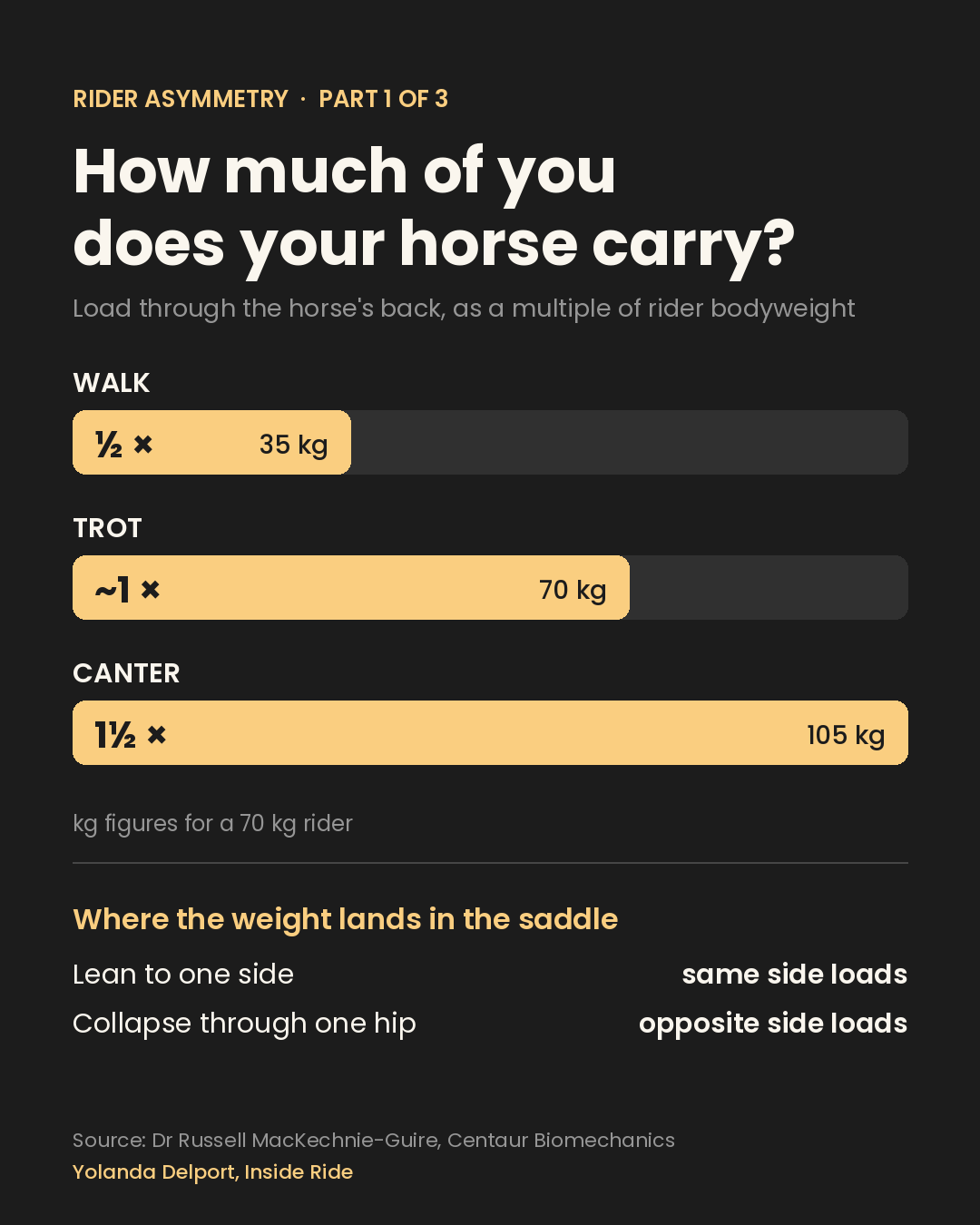
The less comforting news is that our horses feel all of it. By Russell's figures, a horse carries roughly half the rider's bodyweight through its back in walk, around a full bodyweight in trot and about one and a half times in canter. For a 70 kg rider, that's around 105 kg landing on the horse's back with every canter stride. That's a lot of rider to carry unevenly.
Masters of compensation
Russell calls horses masters of compensation. If we sit heavier on one side, they quietly adjust. They shorten a stride, stiffen through the back, and find a way to carry on. Generous creatures. The catch is that a polite adjustment can turn into a habit. A horse we've labelled "stiff to the left" may have started that way because of what was happening in the saddle.
One detail is worth pausing on. If you lean to one side, more weight lands on that side of the saddle, which makes sense. If you collapse through one hip, the weight lands on the opposite side. So the side that feels heavier to you isn't always the side your horse is carrying.
Mileage alone won't straighten us out
You might expect riders to get straighter the more they ride. In one of Russell's studies, 132 riders from introductory to elementary level were measured with 3D motion capture. Asymmetry didn't fade as they moved up the levels. It increased. His view is that hours in the saddle without any work off the horse simply groove the pattern in deeper.
The good news is that a learned pattern can be changed. In Part 2 I'll look at the three most common ways riders compensate, and a simple test you can try on a 20 metre circle.
Until then, notice which seatbone feels heavier when you first sit in the saddle. Just be curious about it. No fixing required.
Yolanda Delport, Inside Ride